Bring the customer complaint, repair history, and technician findings together. Locomotion organizes hypotheses and shows what still needs checking, so your team can decide how to move the repair forward.
From the first hypothesis to the final road test, every stage has a purpose and a human decision.
Analysis A
Know what to check first.
Use the complaint and decoded VIN to generate pre-drive hypotheses, informed by available repair history and transmission knowledge.
Inputs used and supporting evidence
Missing evidence and confidence rationale
Suggested next checks
Analysis B
See what the new evidence changes.
Add test-drive observations and scanner codes, or confirm a clean scan. Compare the updated analysis with the initial hypotheses.
Road-test and scanner findings
Changes between Analysis A and B
A final conclusion your team edits and confirms
YOUR TEAM MAKES THE CALL
Finish with a documented result.
Review the assignment and staged parts. After repair, record the road test and code recheck to confirm the outcome. Verification before invoicing, delivery, or closeout for Locomotion-managed cases.
FROM COMPLAINT TO CASE
A better diagnosis starts with the customer's words.
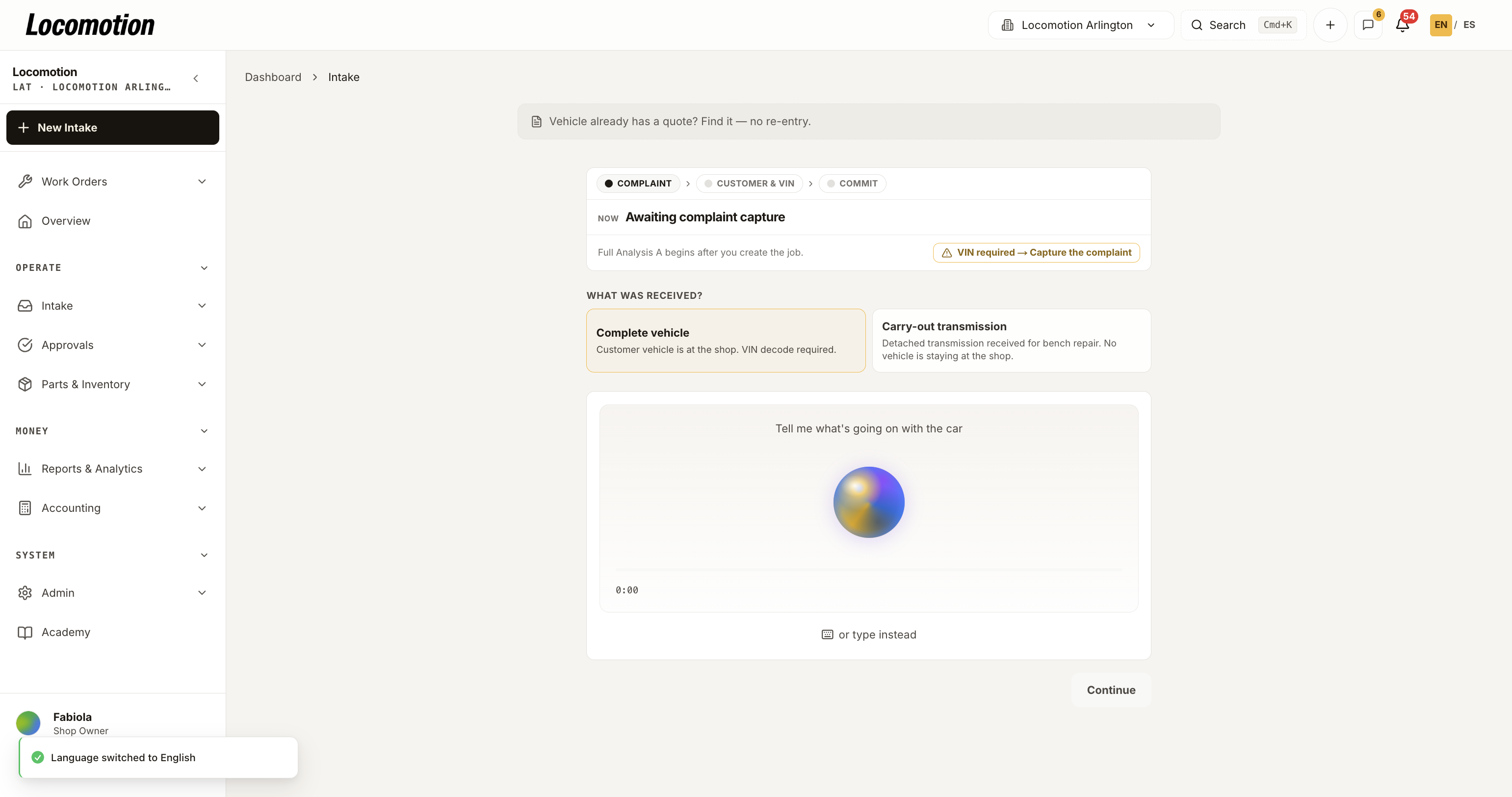
Capture the complaint by voice or text, review the details, and confirm the vehicle. The same case brings the analysis, repair evidence, and final verification together.
Actual Locomotion interface · Voice or manual intakeClick to enlarge ↗
KNOWLEDGE WITH CONTEXT
Repair history
Available historical cases, jobs, parts, and outcomes relevant to the vehicle in front of you.
Transmission knowledge
DTC logic, transmission-family knowledge, and relationships between symptoms and failure patterns.
Optional references
External or licensed sources when available. The core diagnosis workflow can run without them.
Your team reviews and can edit recommendations. Final conclusions, assignments, parts decisions, and verification require human confirmation. AI analysis is decision support, not a guaranteed diagnosis.
Can we keep using Tekmetric?
Yes. Locomotion preserves synced work orders as operational records and lets your team bring active orders into diagnosis when needed. Locomotion verification applies to cases managed here, including orders adopted from Tekmetric.
What evidence can technicians add?
The case brings together test-drive observations, scanner codes, photos, and notes. Guided teardown capture offers assistive visual analysis; technicians still need to inspect and confirm findings. Coverage depends on the evidence, transmission family, and sources available.
What will we see in a demo?
We'll walk through intake, Analysis A/B, human conclusions, parts, and verification, alongside the setup and integrations your shop needs.
TELEPHONE ASSISTANT MODULE
Your front desk. Even after closing.
A 24/7 telephone assistant for transmission shops. Explore how an incoming call becomes a request your team can review, with the complaint and next step in context.